
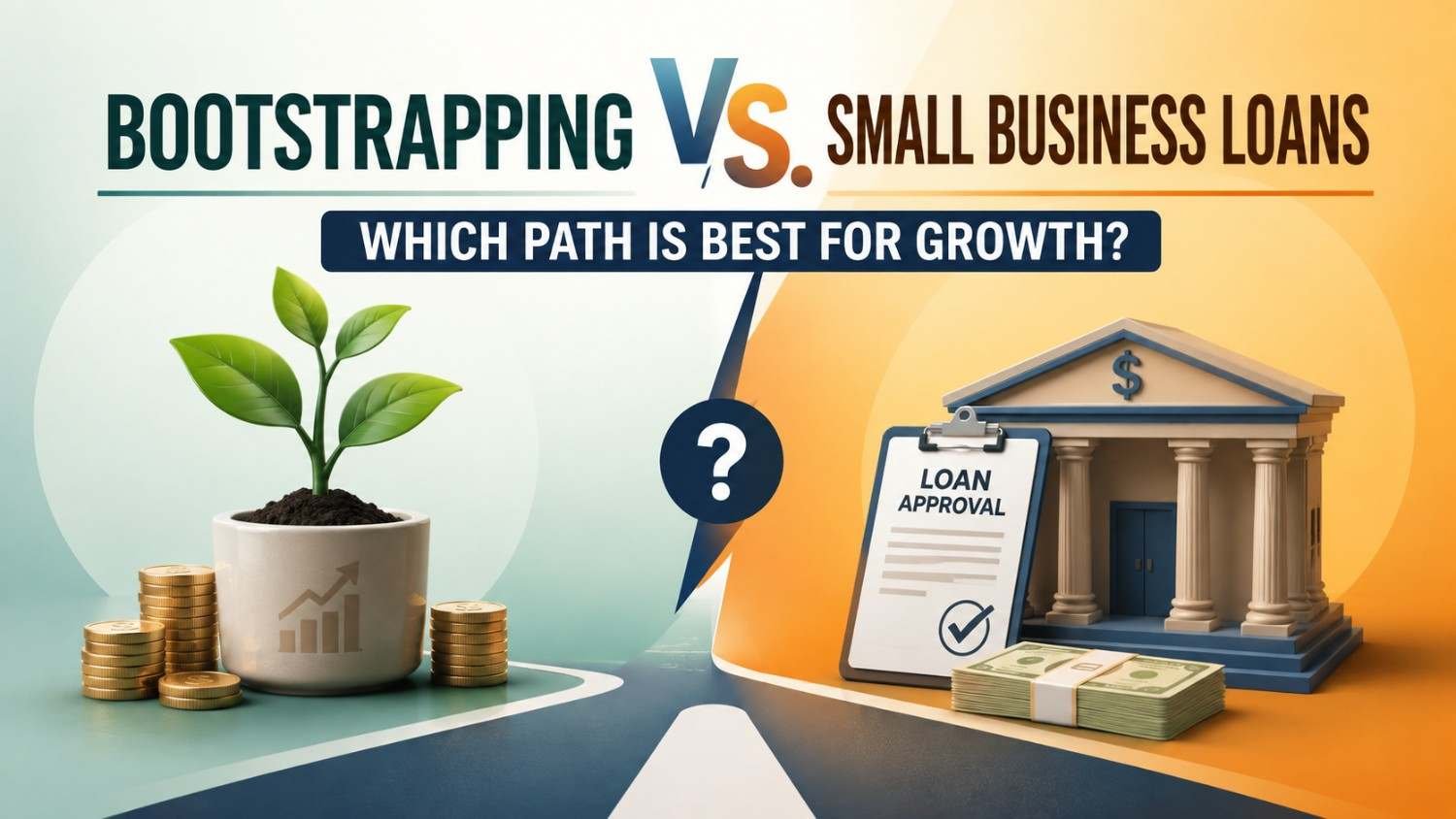
Growing a small business usually takes more money than the founder has sitting there right now. You might need cash for inventory, tools, hiring a few employees, marketing, technology, a new place to operate, or simply working capital to keep everything moving. The tricky part really isn’t just how to get money at all, but more like how to support business growth while not piling on extra financial strain. Two usual routes show up again and again: bootstrapping, where the owner leans mostly on personal savings plus business revenue, and small business loans, where the company takes in capital upfront and then pays it back over time.
Both can work, but they bring along very different obligations, in practice. Bootstrapping can help keep ownership intact and keep debt lower, yet it can mean growth feels slower when cash is tight. A loan can deliver faster capital and push expansion ahead, however interest and repayments can stack up, plus there are eligibility rules and cash-flow pressure which adds risk. Knowing the difference between bootstrapping and small business loans can make it easier for founders to select financing that fits their business model their growth stage, their comfort with risk, and whether they can reliably produce predictable cash flow.
What Is Bootstrapping?
Bootstrapping is like growing a company mostly off the founder’s own resources, and the money the business manages to make on its own, you know. Instead of getting a big chunk of capital by borrowing, or bringing in outside investors, the owner just cycles whatever money is available back into operations and expansion. So a bootstrapped venture might begin with personal savings, land its first real sales, and then turn those profits into buying inventory, adding staff, improving marketing, or even building new products. With this method, you often end up with pretty strong financial discipline, because each big spend really has to be defended by the cash that’s actually on hand. But still, bootstrapping also means you have to accept that growth may move at the pace the business can financially carry, even if you’d prefer it to be faster.
What Is a Small Business Loan?
A small business loan is money a lender provides to a business, and the business agrees to repay it later, under set terms. Depending on the lender and the loan type, repayment can involve principal, interest, fees, and other charges too. You can use loans for lots of things, like equipment, working capital, stock or inventory, expansion, technology, or property upgrades. The main upside is getting capital before the business has generated internal cash to cover the whole project by itself. The main obligation though is repayment. So founders really need to be clear on how much they can borrow, and just as importantly, whether future cash flow can support the repayment plan, comfortably.
Bootstrapping vs. Small Business Loans: Quick Comparison
| Factor | Bootstrapping | Small Business Loan |
| Ownership | Usually retained by founder | Usually retained by founder |
| Debt | No loan debt | Creates repayment obligation |
| Growth speed | Often slower | Potentially faster |
| Interest cost | None on borrowed capital | Interest and possible fees |
| Financial pressure | Lower debt pressure | Regular repayment required |
| Control | High | Generally high, though lender terms apply |
| Qualification | No lender approval | Credit, financials, collateral or other requirements may apply |
| Risk | Personal capital and slower growth | Debt and cash-flow risk |
| Best suited for | Sustainable, gradual growth | Clear opportunities requiring upfront capital |
The right choice depends less on which option sounds safer and more on the economics of your specific business.
1. Consider How Much Capital You Actually Need
The first question should be simple: How much money does the business genuinely need?
If you only need a relatively small amount of funds to purchase inventory or cover basic marketing, bootstrapping can be rather practical. But if expansion means expensive equipment, a larger facility, a hefty inventory load, or substantial working capital, self funding might end up taking too long, for real. Before you decide on any financing option, make a detailed capital requirement, write it down and be precise. Also, separate essential costs from optional expenses, otherwise things get muddled pretty fast.
For example:
- Equipment.
- Inventory.
- Employees.
- Marketing.
- Technology.
- Rent or property.
- Working capital.
- Emergency reserve.
This prevents a common mistake: borrowing more than the business actually needs.
2. Evaluate Your Current Cash Flow
Cash flow is one of the most important factors when deciding whether debt is appropriate. A profitable business can still have trouble repaying a loan if customer payments arrive late, or expenses move around a lot. Look back at your historical cash inflows and outflows. Then ask yourself if the business produces enough dependable cash to cover the monthly loan payments even when things get slower. If revenue is really seasonal, repayment should be judged across the whole annual cash-flow routine, not just the best months. Cash-flow steadiness should matter more than optimism when you’re considering debt.
3. Bootstrapping Gives You Greater Financial Control
One of the strongest benefits of bootstrapping a business is control over financial decisions. Without a huge loan payment hanging over everything, founders can decide when, and how fast to put revenue back to work. If sales dip temporarily, the company can usually trim spending without the pressure of a fixed debt duty. Bootstrapping also pushes founders to focus on profitable customers and long-term unit economics. The tradeoff, is that limited capital can stop the company from acting quickly on opportunities that demand immediate investment.
4. Loans Can Accelerate Business Growth
A loan can still be a good move when the business has a clear chance that needs up-front cash. Think about a company that keeps selling more products than it can actually keep in stock. If extra inventory would raise revenue, but the company doesn’t have enough cash on hand to buy it, borrowing might help. In that case, the business could increase inventory and bring in more sales. The key question is whether the expected payoff from that investment is strong enough to cover the financing cost, and the repayment risk.
5. Understand the True Cost of Borrowing
A loan really shouldn’t be judged just by the money that comes in. It’s better to look at the entire repayment duty, like what you owe back.
Important factors can include:
- Interest rate.
- Annual percentage rate where applicable.
- Origination fees.
- Processing fees.
- Prepayment conditions.
- Collateral requirements.
- Repayment period.
- Late-payment consequences.
- Variable versus fixed interest terms.
Then, compare the overall financing expense with the expected financial gain from using the borrowed funds. This step is a major piece of careful Small Business Financing, you know, the responsible sort of thing.
6. Bootstrapping Can Protect You From Debt
The biggest financial advantage of bootstrapping is kind of simple: you are not taking on a loan just to grow. There is no monthly loan repayment quietly eating up future operating cash. That can be especially helpful for businesses with revenue that feels unpredictable, you know, it moves around a lot. Still, bootstrapping is not totally risk-free
Founders might pour personal savings into the company, postpone their own income, or miss out on faster expansion, because the money that is available is just limited, period. So the comparison should not be “debt is dangerous and bootstrapping is safe.” Both paths have risk , they only spread it out differently.
7. Loans Can Be Helpful for Revenue-Generating Investments
Debt can make more sense when the borrowed funds are tied to a business opportunity you can actually measure. Like, a loan might pay for equipment that boosts production capacity, or technology that cuts operating costs in a significant way. In other words, the investment should come with a clear business argument.
Ask:
How will this money generate enough additional cash to justify its cost?
If the answer feels a bit unclear, taking on debt might be too soon or just, premature. A loan ideally should back a specific investment with clear, measurable financial outcomes, not only patch up uncontrolled operating losses that keep happening.
8. Consider Your Business Stage
A brand new company and a more established company can end up needing very different ways to finance things. In the early phase, you usually don’t have much of a track record, and revenue can be erratic. So bootstrapping may fit better while you’re still validating the idea. Once there’s an established business, plus steady revenue, solid financial records, and a model that’s already been proven, then more financing routes open up.
For these businesses, borrowing can still be useful for expansion, but it lets the founder keep ownership. As the business becomes more predictable, the financing strategy should naturally shift and tighten.
9. Think About Ownership and Control
Bootstrapping and loans aren’t the same as getting equity investment. When you bootstrap, you typically keep ownership , because you aren’t handing out shares to outside investors. A standard business loan usually also does not ask for ownership transfer to the lender. Still, borrowing brings obligations, and often contractual terms you have to live with.
The founder should really understand the gap between keeping ownership and having total financial freedom. You can hold onto equity, yet still have serious repayment responsibilities that can’t be ignored.
10. Don’t Borrow to Cover a Weak Business Model
This is basically one of the most important rules for entrepreneurs. Debt can bring cash, but it can’t automatically fix weak demand, weak pricing, uncontrolled expenses, or a business model that isn’t working. If the company keeps losing money because customers aren’t willing to pay enough to cover costs, then taking on extra borrowing may just make the eventual situation larger , not better. . Before seeking financing, identify the underlying reason for the funding requirement. Ask whether the money is being used to accelerate something that already works or to compensate for something that does not.
11. Know When Bootstrapping Makes More Sense
Bootstrapping may be attractive when:
- The business can grow gradually.
- Startup costs are relatively low.
- Customers pay quickly.
- Profit margins are healthy.
- The founder has sufficient savings.
- External capital is not essential.
- The business model is still being tested.
In these situations, maintaining financial flexibility can be more valuable than pursuing rapid expansion.
12. Know When a Small Business Loan May Make Sense
A loan may be worth considering when:
- Revenue is relatively predictable.
- The business has a clear use for the capital.
- The investment has measurable expected returns.
- Loan repayments fit comfortably within cash flow.
- The company has appropriate financial records.
- The opportunity could be lost without timely funding.
The key is not simply qualifying for a loan. The key is being financially capable of using debt responsibly.
13. Build a Financial Forecast Before Borrowing
Before accepting financing, create several scenarios.
At minimum, model:
Base Case: What happens if the business performs as expected?
Downside Case: What happens if revenue falls significantly?
Upside Case: What happens if the investment produces better-than-expected results?
Your forecast should cover loan repayments, the day to day operating costs, taxes, payroll, inventory, and other recurring commitments, so you’re not guessing later. If the business can limp through the downside scenario and not hit a liquidity crisis right away, then the financing decision starts to look a bit more defensible, even if things get wobbly.
14. Keep an Emergency Cash Reserve
One thing founders sometimes do is pour every available rupee or dollar into growth. Growth needs cash, yes, but the reality is businesses also get hit with unexpected expenses.
A cash reserve can provide protection against:
- Slow sales.
- Equipment failures.
- Delayed customer payments.
- Unexpected repairs.
- Supplier problems.
- Emergency operating costs.
If taking a loan would leave the company with almost no cash after the investment , then sort of rethink the financing structure. A growth strategy shouldn’t create unnecessary fragility, that is really the gist.
15. Don’t Confuse Revenue Growth With Financial Health
A company can boost revenue while its financial health quietly deteriorates. Say sales climb 30% , but inventory costs, marketing expenses, payroll costs, and debt repayments climb faster anyway. The business can look like its booming while cash gets tighter and tighter. So don’t just watch revenue, track more than revenue.
Important metrics include:
- Gross margin.
- Operating margin.
- Operating cash flow.
- Customer acquisition cost.
- Customer lifetime value.
- Accounts receivable.
- Inventory turnover.
- Debt service obligations.
These numbers provide a clearer picture of whether growth is actually creating financial value.
16. Consider a Hybrid Funding Strategy
The decision doesn’t always need to be completely bootstrapping or fully debt-funded. A business can, sort of, combine internal cash with carefully selected financing, in a way that feels less rigid. For example, the founder could fund the first expenses using business revenue, and then leverage a loan that is specifically for equipment that ends up producing measurable extra revenue. This can keep the debt portion smaller while still giving access to growth capital. A hybrid strategy should still be checked, pretty carefully against cash flow and the ability to repay, otherwise it becomes a bad idea.
17. Compare Financing Based on Business Purpose
Different business needs can justify different financing approaches.
For example:
Inventory: It could be covered through retained earnings, or maybe even a short-term credit arrangement depending on how fast everything turns over.
Equipment: A term loan, or equipment financing, might fit better if that asset is actually going to bring in income across multiple years, not just briefly.
Marketing: Bootstrapping can be the better route at first, until the campaigns start showing clear, repeatable returns.
Emergency working capital: A proper credit facility might give needed flexibility, but the charges and payback terms really should be checked, twice.
And honestly, there’s no single financing trick that works for every kind of expense
18. Improve Financial Discipline Before Seeking Funding
Before applying for Small Business Loans, organize your financial records. Lenders might check the financial statements, revenue background, creditworthiness, business plan , cash flow, existing obligations and other related details depending on the particular loan and lender. Even when paperwork is not rigidly needed, having well arranged financial records helps the founder make better decisions.
Know:
- Monthly revenue.
- Monthly operating costs.
- Current cash balance.
- Existing liabilities.
- Expected receivables.
- Gross margins.
- Break-even point.
Good financial visibility makes financing decisions less emotional and more evidence-based.
19. Avoid Choosing Funding Based Only on Speed
Quick access to money can feel really appealing when a business hits a sudden, urgent chance. Still, moving fast should not just stand in for due diligence. If you can, compare several funding choices, and make sure you understand the complete cost, fees, and terms before you sign anything. Go through the agreement carefully, and if the financing setup gets complicated, or if the amounts are big, then ask for proper financial or legal guidance. Also, the option that looks the cheapest upfront is not necessarily the least expensive once you think about the entire repayment timeline.
20. Use a Simple Decision Framework
Ask yourself these questions before deciding:
Can the business grow using existing cash?
If yes, bootstrapping may provide a lower-risk path to gradual growth.
Is there a time-sensitive opportunity?
If waiting could cause a measurable loss of revenue, financing may deserve consideration.
Can the business comfortably make repayments?
If not, borrowing may create unnecessary pressure.
Will the borrowed money generate measurable returns?
If the answer is unclear, investigate the business case further.
What happens if revenue falls?
Stress-test the business before taking on debt.
Does the financing support a proven business model?
If yes, debt may be more defensible than using it to cover persistent structural losses.
Bootstrapping vs. Loans: Which Is Better?
It’s not really a single answer, more like depends. Bootstrapping might work better for founders who really want that control , have costs that are not too huge and can expand in a calm steady way just from the revenue. Then again, a small business loan could be the better route when there’s already an established company with dependable cash flow, plus a solid investment path that needs money up front. In the end the best funding choice is the one that lets the business grow without piling on financial duties it can not handle with ease. How fast you scale matters, but steady sustainable growth matters even more.
Common Mistakes to Avoid
Borrowing More Than Necessary
More capital can create extra repayment pressure, so borrow based on a clear business ask , not just because you can.
Ignoring Cash Flow
Revenue by itself doesn’t really say if the business can repay the debt, it’s cash movement that matters.
Using Debt for Recurring Losses
Debt can help fund a smart initiative, but if losses keep happening, that’s a sign for a deeper business-model check, not a “keep going” signal.
Spending Personal Savings Without Limits
Bootstrapping shouldn’t turn into draining every personal asset at once , there should be a boundary.
Failing to Read Loan Terms
Before you sign, make sure you understand the full repayment duty, any fees, collateral rules , and what happens if things slip.
Growing Too Quickly
Fast expansion when operations and finances aren’t ready can cause trouble, even when sales look strong and trending up.
How to Create a Sustainable Growth Funding Strategy
A solid Business Growth Funding plan should really line up with the company’s current financial reality . Start with internal cash generation where it makes sense , not just because it’s safe, but because it’s there. After that, look for particular opportunities where outside money could actually build measurable value. Keep a financial reserve around , and keep checking cash flow all the time. Most importantly, don’t treat financing like some kind of silver bullet or a fix all, financing is a tool , and it only works if the business is already performing well. Capital can speed up a strong business, sure , but lasting expansion still leans on customers, margins, day to day operations, product quality, and sharp management.
Conclusion
Picking between bootstrapping and a small business loan is basically a choice about risk, control, cash flow, and how fast you want to grow. Bootstrapping helps protect financial flexibility, and it tends to push disciplined spending. Meanwhile, borrowing can give you the cash you need to chase bigger opportunities sooner. Neither route is automatically “better” though. Founders should check their business stage, what funding they truly require, how predictable their cash flow is, what return on investment they expect, whether they can repay reliably, and whether they still have financial reserves. If the business has limited capital and growth goals that can bend a bit, bootstrapping might be the sensible first move. If the company is already established, with steady cash flow and a clearly profitable expansion path, a well-structured loan could accelerate progress. The best financing strategy is the one that supports growth without trading away the long-term financial health of the business.
Frequently Asked Questions
1. Is bootstrapping better than taking a small business loan?
Bootstrapping can be better when a business can grow gradually without significant capital. Loans may be more suitable when predictable cash flow supports borrowing for a clear growth opportunity.
2. When should a small business consider taking a loan?
A business should consider borrowing when it has a specific use for the capital, predictable enough cash flow for repayments, and a reasonable expectation that the investment will create additional value.
3. What is the biggest advantage of bootstrapping?
The biggest advantages are greater financial control, no loan repayment obligation, and the ability to grow according to the company’s internally generated cash.
4. What is the biggest risk of small business loans?
The primary risk is repayment pressure. If revenue falls or cash flow becomes unpredictable, fixed debt obligations can make financial problems more difficult to manage.
5. Can a business combine bootstrapping and loans?
Yes. A hybrid approach can allow founders to use internal cash for some expenses while borrowing for specific investments that have clear financial benefits.
Leave a Reply