
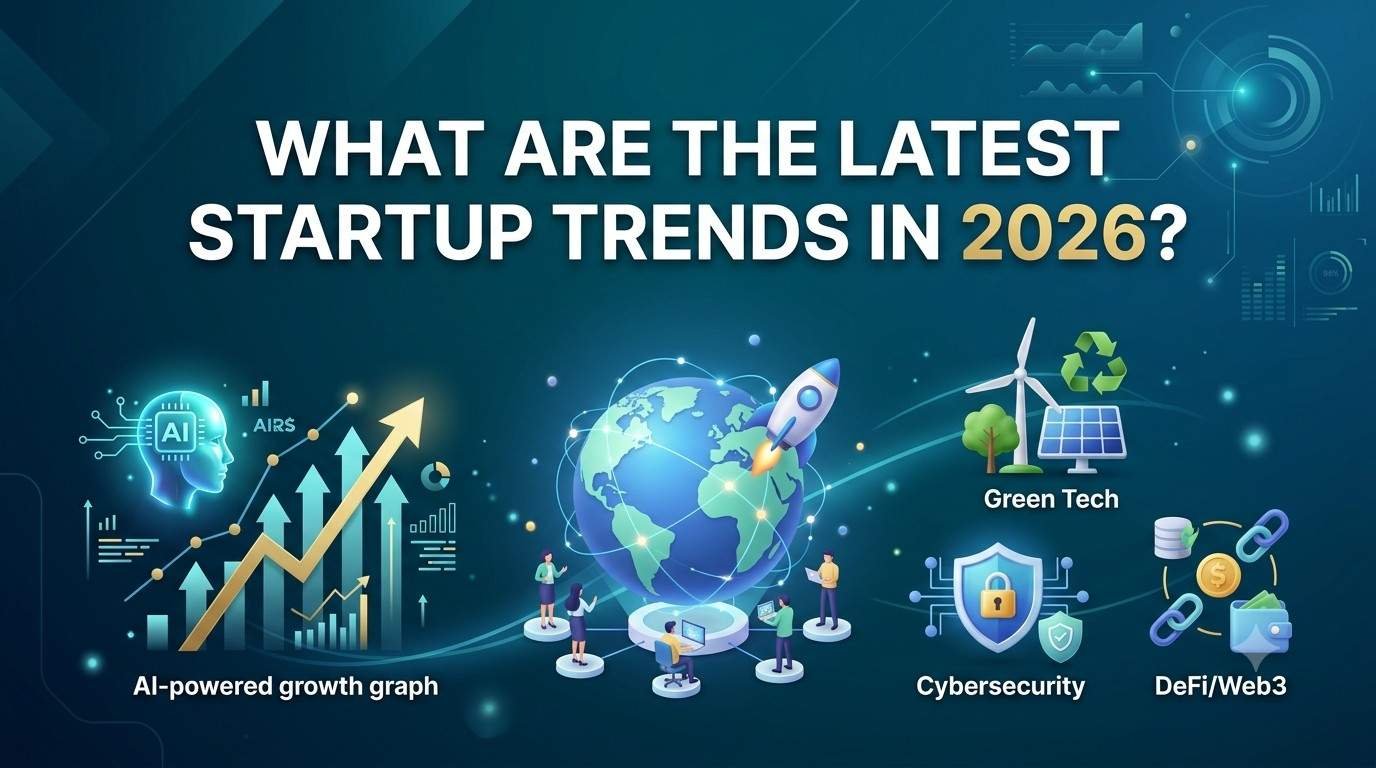
The startup world is moving real fast lately. New technologies, customer expectations that keep shifting, tighter funding, and also these changing economic priorities are making founders rethink how they build and grow… for real. Back when money was easier, some strategies worked , but now they’re not enough. Right now startups need to show value faster, keep costs under control, and ship products that actually solve obvious problems.
The most important startup trends 2026, in my view, are more about practical innovation than pure hype. AI-native companies, vertical software, businesses that bootstrap themselves, climate solutions, cybersecurity, specialized marketplaces, and capital-efficient growth are getting more attention every month. For founders , understanding these latest startup trends can point to new openings, help you sidestep outdated methods, and support better choices around products, funding, hiring, and overall growth.
1. AI-Native Startups Are Growing Rapidly
Artificial intelligence is no longer just a “nice feature” that startups tack onto older products. A lot more founders are building companies where AI stays at the core of the product, the workflow, or even the entire business model. These startup chances around AI include automated customer support, research platforms , specialized agents, content systems, coding tools, healthcare applications, and business intelligence products. The biggest chance usually isn’t “making yet another general chatbot” it’s applying AI to a specific, narrow pain. Successful founders are also asking a different question now: not only where AI can be added, but what work can be redesigned around AI.
Common opportunities include:
- AI-powered business operations.
- Industry-specific AI assistants.
- Automated research and reporting.
- AI customer support.
- AI-powered sales workflows.
2. AI Agents Are Moving Into Business Workflows
Generative AI can spit out text, images, code , and other outputs , but AI agents are built to take several actions in order to hit a goal. That difference makes new space for startups that automate complex workflows instead of just one small task. An agent might look up relevant info, update a database, draft an email, examine documents, and then compile a report, all within a single process kinda like a coordinated assistant.So yeah, that is one big reason AI agent startups are getting so much attention lately. The chance feels especially big in the spots where companies do repetitive, multi step “knowledge work”. Still, reliability, security, human supervision, and integration keep showing up as real hurdles. In the end the best products will probably blend automation with obvious guardrails, not try to eliminate people from every workflow, because that just usually fails in practice.
3. Vertical SaaS Is Becoming More Attractive
Software as a service has been a big startup category for years, but it seems like a real opportunity is showing up in vertical SaaS—software made for just one industry. Instead of building some generic project management platform, a startup could make something tailored for dental clinics, construction companies, property managers, restaurants, logistics firms, or legal practices. By taking that route founders get to see the narrow customer’s problems in a much deeper way, kinda more precise, less guesswork.
Why vertical SaaS is attractive:
- Clearer customer needs.
- More specialized features.
- Easier positioning.
- Potentially stronger customer loyalty.
- Opportunities to integrate industry-specific workflows.
For founders chasing vertical SaaS opportunities, taking on a tough problem inside one industry can feel more real, than jumping into an overcrowded general purpose software market where everyone’s trying to sound the same.
4. Capital-efficient startups are back
A major shift in entrepreneurship is that people are paying more attention to efficiency. In earlier periods where venture capital was plentiful, some startups pushed for fast user acquisition and market share, even if profitability was still months or years away. Now the environment has nudged founders to look harder at revenue, margins, how well customers stay, and what the day to day actually costs. This is why capital efficient startups are feeling much more relevant lately, not just as a nice idea but as a practical path forward.
Founders are asking:
- Can we build the first version with a small team?
- Can customers pay early?
- Can automation reduce operating costs?
- Can we grow without raising large funding rounds?
- Can revenue finance part of the expansion?
This approach doesn’t mean startups should never raise capital. It’s more like the funding ought to back a real, proven opportunity, not kind of substitute for product-market fit.
5. Bootstrapping Is Turning Into a Real Growth Path
Bootstrapping gives founders more control because the company tends to grow mostly from customer revenue and the founder’s own resources , rather than relying on outside investment. The whole model can work especially well for software companies, agencies that are shifting into products, niche e-commerce ventures, consulting-turned-products, and specialized digital services.
A bootstrapped startup strategy can really nudge founders to stay close to customers , since revenue becomes an immediate scoreboard for whether the business is actually creating value. The downside is slower expansion, plus there may be fewer resources for hiring and marketing. Still, founders who care about independence, and who prefer steady progress, often find this route more appealing.
6. Startups Are Tackling More Focused Issues
Another trend that’s hard to miss is the move toward niche offerings. Instead of aiming at everyone, startups are increasingly zeroing in on narrowly defined customer groups with particular problems. Like, rather than building a generic productivity tool, a company could create a platform built for freelance designers who need to manage client approvals.
That’s basically a niche startup business model. A smaller audience can make marketing less messy because the message can be more direct , more specific. It can also help founders gather stronger feedback and build features that match real customer needs, not just guesses.
7. Cybersecurity Startups Are Becoming More Important
As businesses keep adopting cloud platforms, AI systems, remote work tools and connected devices, cybersecurity risks sort of keep shifting and changing too. At the same time , startups are building products around identity management, threat detection, data protection, AI security, privacy, compliance, and even automated security monitoring, like end to end kind of stuff.
And yeah, the rising use of AI adds a whole new set of security needs. Companies still have to safeguard models and prompts, protect sensitive business information, lock down APIs, and secure AI generated workflows. So, cybersecurity startup ideas feel especially relevant for founders who have technical depth and industry experience, because they can actually map the threats to real controls.
8. Climate Tech Is Moving Toward Practical Solutions
Climate technology is still a major startup lane, but the spotlight is moving toward approaches that can show economic value , not just big promises. Startups are working on energy storage, carbon management, sustainable materials, electric mobility, renewable energy infrastructure, agricultural technology, water management, and energy efficiency.
The chance here is not only about “breakthrough” science either. There’s also real momentum in software and services that help organizations measure, oversee, or reduce energy and resource consumption. That’s where climate tech startups can blend sustainability with outcomes that look measurable for the business.
9. Health Tech Is Becoming More Personalized
Healthcare startups are increasingly looking at tech that can actually support personalized care, remote monitoring, digital health services, diagnostics, and also preventive wellness, you know, the whole thing. Wearable devices and connected health technologies can produce more information about individual users. And AI, well that can help sort through huge amounts of data too, faster than humans.
Still, healthcare startups deal with tighter rules than a lot of other tech companies. Founders have to think about privacy, medical accuracy, regulatory requirements, cybersecurity, and clinical evidence. So the best digital health startup trends tend to mix real technological innovation with strong proof, plus a responsible way of building the product, not just “ship it and hope”.
10. The Creator Economy Keeps Creating Startup Opportunities
Creators, influencers, educators, writers, video producers, and independent professionals are building businesses based on their audiences. That has opened doors for startups that offer tools for content production, monetization, community management, analytics, digital products, payments, and audience engagement.
And the creator economy is not really stuck only on social media personalities. Experts and professionals can also form highly specialized communities around knowledge, or specific skill sets. So startups that help creators turn their attention into steady revenue should still be able to spot opportunities, over and over, in different shapes.
11. Marketplaces Are Becoming More Specialized
Large marketplaces dominate many mainstream categories, but specialized marketplaces can still solve important problems. A marketplace focused on a particular profession, geographic region, service type, or industry can offer more relevant discovery and trust mechanisms.
For example, a marketplace could connect specialized consultants with businesses that need a specific technical skill. These specialized marketplace startups can compete through expertise rather than simply attempting to have the largest number of listings. Trust, verification, quality control, and efficient matching are particularly important in this model.
12. Startups Are Using No-Code and Low-Code Tools
Building a startup no longer always requires a large engineering department. No-code and low-code platforms allow founders and small teams to create prototypes, automate workflows, build internal tools, and test ideas more quickly.
Combined with AI coding assistants, these technologies can significantly reduce the cost and time required to develop an early product. This is particularly useful for founders who want to validate an idea before making a major technical investment. The important principle is to use these tools for experimentation while investing in more robust infrastructure when the product begins to scale.
13. Product-Led Growth Is Becoming More Important
Product-led growth basically uses the product itself as some kind of key piece in customer acquisition and conversion. Instead of going “all in” on sales reps, a company might let customers try the product first, feel the real value, then upgrade later when they suddenly need extra capabilities.
Freemium models, free trials, product demos, self-service onboarding, and interactive experiences can all support this strategy. For startups, product-led growth can reduce customer acquisition friction, when the product shows its value pretty fast, and doesn’t make people wait.
14. Customer Retention Matters More Than Vanity Metrics
Startup success is increasingly judged by outcomes that actually matter, not by downloads, random website visits, or social media follower counts. Founders are paying more attention to customer retention, recurring revenue, conversion rates, customer acquisition costs, and lifetime value. You can end up with a company that pulls in thousands of users, but loses most of them almost immediately, and that might still be weaker than a smaller business with customers that are genuinely loyal.
That’s why startup customer retention strategies deserve equal focus alongside acquisition. When you understand why customers leave, you can uncover product issues that marketing alone simply cannot fix, no matter how clever the messaging is.
15. Founder-Led Marketing Is Growing
Early-stage startups usually can’t match established companies when it comes to advertising budgets. Founder-led marketing then becomes another route, sort of a different “lane” to drive attention.
Founders can publish educational content, share industry insights, join communities, show up on podcasts, answer questions, and build relationships with potential customers. This route can create credibility, while also helping founders learn what their audience really wants. It is especially effective for B2B startups, because B2B customers often want to see the expertise behind a product before making a purchase.
16. Alternative Funding Models Are Expanding
Venture capital still matters, but it’s not the only road anymore for people building startups, you know. Founders might look at revenue based financing, crowdfunding , angel investment, government grants, strategic partnerships, customer funded development, or just bootstrapping altogether. Which choice fits best depends on the business model, how much cash is needed, what kind of growth they expect, and what the founders actually want to optimize for. For instance, a company that can turn revenue on fast may not need the exact same money plan as a biotech startup that has to spend years in research before anything meaningful shows up. Really the big theme here is more flexibility, like founders are thinking broader about how startup funding alternatives can work, not just VC.
17. Remote and distributed teams are getting way more specialized
Remote work has changed how startups hire talent. A young company can recruit specialists from different cities or even different countries, rather than being stuck to one nearby local market. But remote teams also mean you need firmer communication systems, solid documentation, project management discipline, cybersecurity, and real performance measurement. So startups are becoming more deliberate about when people should work fully remote, when they should collaborate online, and when it makes sense for folks to be in person.
18. Startups are focusing on real customer problems
Maybe the biggest trend is a kind of return to basics. Having tech is not automatic enough, it doesn’t guarantee anything by itself. A startup needs a genuine customer problem, a clear value proposition, a practical solution, and a sustainable way to generate revenue. That’s why founders should validate their assumptions early, before they pour too much effort into development and hope it lands.
A practical validation process can include:
- Interviewing potential customers.
- Identifying repeated problems.
- Building a simple prototype.
- Testing willingness to pay.
- Measuring early usage.
- Improving the product based on feedback.
This approach reduces the risk of spending months building something customers do not actually need.
How Founders Can Take Advantage of These Trends
Following every trend is kinda not a good startup strategy. Instead, founders should figure out which trends actually overlap with their skills, industry knowledge, customer connections, and the resources they can reach right now. For instance, a healthcare professional might look into AI-powered healthcare tools, while a cybersecurity specialist could build specialized security software. A marketing professional might create an AI-powered content workflow, and a construction expert could develop vertical software for contractors.
Most of the time the best startup opportunity lives right there at the intersection of technology plus industry expertise plus a real customer pain.
What Will Matter Most for Startups in 2026?
The startup ecosystem is getting more practical. Investors and customers are asking for real value more often, not just big talk, or ambitious projections with shiny numbers. The companies that seem strongest will likely be the ones that mix technology with efficient execution. They’ll get their customers, track the outcomes, safeguard data, keep costs under control, and adjust fast.
AI will stay a major force, but it won’t erase the basics of entrepreneurship. Like if you take a great technology and drop it on a weak problem, well then you still end up with a weak business .
Conclusion
In 2026 , the newest startup trends look like they are shifting toward practical innovation and growth that is more efficient, plus products that are narrower, and a sort of technology powered productivity. you can see it in AI-native companies , AI agents everywhere, vertical SaaS, cybersecurity, climate technology , digital health, and specialized marketplaces. even bootstrapping still feels strong, and there’s this whole wave of creator tools and product led growth. so yeah, for entrepreneurs it opens a bunch of fresh chances, but at the same time founders really need to step past the hype and just ask what customers actually need. sustainable revenue , retention, security, and measurable outcomes have to be front and center, not just nice slides. the startup ideas that seem most promising are often the ones that mix newer technology with serious industry know how, and a customer problem that’s clearly defined . instead of chasing every trend at once, it probably makes more sense to spot one meaningful opportunity, validate it with real people, then build a business model that can create long term value without wobbling.
Frequently Asked Questions
1. What are the biggest startup trends in 2026?
AI-native businesses, AI agents, vertical SaaS, cybersecurity, climate tech, bootstrapping, specialized marketplaces, and capital-efficient growth are among the major areas attracting attention.
2. Is AI still a good opportunity for startups?
Yes, but simply adding an AI feature may not be enough. Strong opportunities are increasingly found in specialized AI applications that solve specific customer problems.
3. Are bootstrapped startups still successful?
Yes. Bootstrapping can work particularly well for businesses that can reach paying customers quickly and grow through revenue without requiring large upfront capital.
4. What is vertical SaaS?
Vertical SaaS is software designed specifically for a particular industry or profession rather than a broad general market. It can provide highly specialized workflows and features.
5. What should entrepreneurs consider before following a startup trend?
Founders should evaluate customer demand, competition, technical feasibility, startup costs, monetization potential, regulatory requirements, and whether the trend solves a genuine problem.
Leave a Reply