
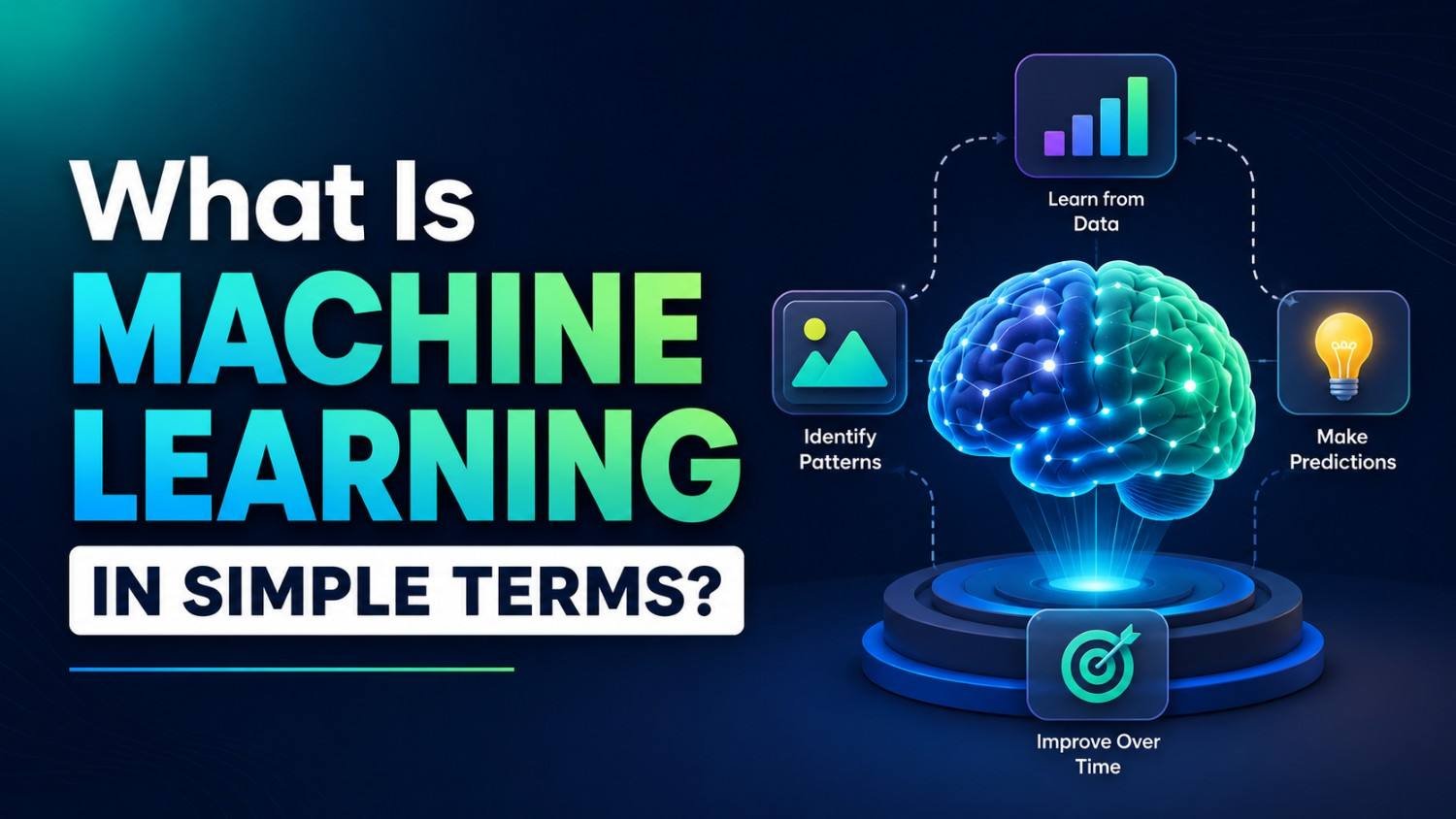
Have you ever, like actually, wondered how your phone recognizes your face, how Netflix recommends a movie you might enjoy, or how an email service decides a message looks like spam. It can feel kinda magical, but really it’s all powered by systems that spot patterns and then make predictions from whatever information they’re given. The tricky part is that terms like artificial intelligence, algorithms, neural networks, and machine learning can sound way more involved than they need to be. For beginners, it can feel like trying to understand a machine by holding it in your hands, but never seeing what’s inside, so to speak.
The good news is that Machine Learning can be explained without heavy, complicated mathematics or programming speak. At its most simple level, it’s a way of teaching computers to learn patterns from data, so they can make useful predictions or choices without someone writing rules for every single scenario. Once you get that core notion, ideas like supervised learning, training data, neural networks, and predictive models start to click, not as a big cloud of terms, but as connected pieces. This guide walks through machine learning basics, bit by bit, it explains how the whole thing works, looks at everyday examples, and shows why it matters in our more and more digital world.
What Is Machine Learning?
Machine Learning is one branch of artificial intelligence that helps computers kind of learn from data and then get better at a given job without having to be told, for every little situation. Like , imagine you’re teaching a child to recognize cats. You probably would not hand them this huge rulebook, with every single possible detail about cats. Instead you show pictures of cats and maybe other animals, over and over, until the child starts to notice common traits. Machine learning feels similar in that regard: the computer gets examples , then it finds patterns, and it uses those patterns to guess what might be true about new information later on.
For instance , an online store could look at past customer behavior, in order to predict what products a shopper might like. It doesn’t just copy one person’s choices. Rather , it studies patterns across a lot of data, and then it turns those patterns into recommendations. Honestly, this is one of the most straightforward views of how it works: data goes in, the system soaks up the patterns , and then those patterns help it generate useful results.
Machine Learning vs. Traditional Programming
Traditional computer programming kinda has this straightforward vibe to it. A programmer gives certain directions plus rules , the computer just follows those directions and rules, then you get some kind of result or output.
With machine learning it’s different. You don’t usually hand write every little rule yourself, instead developers provide data and a suitable learning method , and then the system figures out helpful patterns on its own.
The difference can be understood through a simple example:
- Traditional programming: Rules + data → output.
- Machine learning: Data + expected outcomes or learning signals → learned model.
- After training: New data + learned model → prediction or decision.
This sort of approach is especially handy when the rules are hard to spell out manually. Things like speech recognition , spotting odd financial transactions , or pointing out objects in photographs , those are cases where writing one separate rule for every single possibility would be extremely difficult, kind of impractical really.
How Does Machine Learning Work?
The whole process starts with data. Data can be numbers, text, pictures, audio, customer transactions, sensor readings, or a bunch of other kinds of information. Then a machine learning system looks at this stuff, to figure out connections and patterns that aren’t obvious. During training , the system keeps tweaking its internal parameters so that the guesses it makes get more and more helpful, based on some objective it’s been set to optimize.
A simplified process looks like this:
- Collect data: Gather relevant examples from reliable sources.
- Prepare data: Clean, organize, and format the information.
- Train a model: Allow an algorithm to learn patterns from the training data.
- Test the model: Evaluate how well it performs on information it has not seen before.
- Deploy the model: Use it to make predictions or decisions.
- Monitor performance: Check whether accuracy remains useful as conditions change.
So this step is basically called machine learning model training, and honestly, how good the training data is , can heavily shape what you end up with in the final results.
What Is Training Data?
Training data is basically the info used so a machine learning system can learn. Like, imagine you’re building something that checks whether an email is spam or not. You might feed it thousands of past emails , each one tagged as spam or as legitimate. Then the system looks at the various signals inside those examples , and it picks up the kinds of patterns that line up with each group, know.
And yeah, the quality of that training data really matters a ton. If the information is incomplete , inaccurate, old , or even overly biased, the resulting model can start making weak guesses. So this is why “data quality” in machine learning is not just a side thought. Even a fancy algorithm can’t just cleanly compensate for fundamentally bad input, no matter how advanced it sounds.
Main Types of Machine Learning
Machine learning is commonly divided into several major approaches. Each is useful for different kinds of problems and data.
Supervised Learning
In supervised learning, the model basically learns from past examples where the right answer is already known. Like, a company might share historical house data, with features such as size, location, and number of bedrooms alongside the known selling prices. Then the model starts figuring out how these variables relate, and it can later estimate prices for properties it has never seen before. You’ll run into supervised learning in spam detection, sales forecasting, image classification, and credit-risk assessment, where outcomes are given up front.
Unsupervised Learning
Unsupervised learning uses data that comes without predefined labels, so there is no “correct category” attached to each record. Instead of telling the system which bucket every customer goes in, a business could give customer behavior data and ask the model to uncover clusters or groups that share similar traits. This is useful for customer segmentation using machine learning, anomaly detection, exploratory analysis, and even discovering those less obvious hidden patterns. In other words, it’s more about structure “emerging” from the data, not about comparing to known tags.
Reinforcement Learning
Reinforcement learning is different: an agent interacts with an environment, and it gets rewards or penalties depending on what it does. With time, the system learns which actions tend to lead to better outcomes. This has shown up in robotics, game-playing systems, and various setups where decisions unfold in sequence, step after step. The key thought here is that the learning happens via feedback signals, rather than just studying labeled examples in a straightforward way.
What Are Machine Learning Algorithms?
A machine learning algorithm is sort of a procedure for picking up patterns in data and then building a model that can carry out a specific job. You know, different algorithms fit different situations. Some are made for classifying things, some for foretelling numbers, others for clustering kindred samples, or spotting odd behavior .
Common algorithm families include:
- Linear regression
- Decision trees
- Random forests
- Support vector machines
- Clustering algorithms
- Neural networks
But choosing an algorithm is just one piece of the whole puzzle. Data preparation , feature selection, model evaluation,and later deployment can matter as much, even more sometimes, if you want a system that actually works in practice.
What Are Neural Networks?
Neural networks are kind of machine learning model inspired loosely by how biological nervous systems handle information , more or less. They include interconnected computational units which are arranged in layers , kind of like a cascade. Each layer takes in information, then processes it, and sends the useful signals onward to the next layers , sometimes with subtle transformations that you do not really see at first.
Neural networks can be especially strong when dealing with complicated data , like pictures, speech, and natural language. More advanced versions, including deep neural networks, have had a big part in many recent breakthroughs in artificial intelligence. Still, they are not automatically better for every single problem. For certain simpler tasks , classic machine learning approaches may be easier to interpret, faster to get trained, and generally more practical in day to day use .
Machine Learning in Everyday Life
You may already use machine learning dozens of times a day without realizing it.
Examples include:
- Recommendation systems: Streaming services suggest movies, music, and shows based on viewing or listening patterns.
- Search engines: Search systems use numerous signals to understand queries and rank relevant information.
- Email filtering: Machine learning can help identify unwanted or suspicious messages.
- Voice assistants: Speech recognition systems convert spoken language into text and commands.
- Fraud detection: Financial institutions can identify unusual transaction patterns.
- Navigation: Mapping applications estimate traffic conditions and travel times using large amounts of data.
- Personalized advertising: Platforms can predict which advertisements may be more relevant to particular users.
These examples sort of show that machine learning apps arent only in labs or big technology companies. They are already baked into a lot of normal, everyday digital services.
Machine Learning and Artificial Intelligence
Artificial intelligence and machine learning are really tightly related, but they aren’t the same thing. Artificial intelligence is the wider area about building systems that can do tasks that, in the past, usually depended on human intelligence, or at least those human-like parts. Machine learning is just one method, used to make those kinds of systems in practice.
A simple way to visualize the relationship is:
Artificial Intelligence → Machine Learning → Deep Learning
Also, not every AI system automatically uses machine learning, and not every machine learning model necessarily relies on deep learning. When you understand that split, the tech talk gets way easier , because people often mix up these terms as if they mean the same thing even though they actually point to different layers of the overall field.
Benefits of Machine Learning
Machine learning can, in practice, bring really meaningful advantages but only when it is built and put into use in a careful, responsible way. One big payoff is automation. In other words, these systems can sift through massive amounts of information, way faster than people could ever do by hand, so teams can move quickly. That speed can also let organizations spot patterns more easily, make reasonable predictions, and turn repetitive choices into something more routine, basically.Then there is personalization. Companies can use behavioral information to adjust and tune recommendations, content, product suggestions , and services for particular users. Also, machine learning is useful for predictive analytics, which means businesses can estimate demand, flag possible threats or risks, and come up with better decisions overall.
Other potential benefits include:
- Faster data analysis.
- Improved forecasting.
- Automation of repetitive tasks.
- Personalized customer experiences.
- Earlier identification of unusual activity.
- Support for complex decision-making.
Limitations of Machine Learning
Machine learning is powerful, but it is not magic and it is certainly not infallible . A model can come out with wrong answers if the training data is poor, or if the situation shifts after deployment . Also, a system that learned from older information may end up repeating biases that were already inside that material, not because it wants to, but because it has “the past” as a guide.
On top of that, there are added worries around privacy, security, transparency , and accountability. A lot of advanced models are hard to interpret , so it becomes tricky to say exactly why a specific prediction happened. Because of this, a responsible roll out needs human oversight, proper testing , careful data handling , and ongoing monitoring.
Why Machine Learning Needs Human Expertise
It is tempting to believe that machine learning can just replace human decision-making. But in practice, successful setups tend to rely on people in multiple stages. Specialists define the business problem, choose suitable data, assess outcomes, spot risks, and decide how the predictions should be used . Human judgment matters a lot when decisions touch peoples finances, job opportunities, health, privacy, or access to essential services.
A machine learning model might detect a statistical pattern, yet humans still have to decide if it actually makes sense, and if acting on it is the right move. The best strategy is often a kind of teamwork between people and intelligent systems, rather than viewing the technology as a full stop, replacement for expertise .
The Future of Machine Learning
Machine learning will keep affecting lots of different industries, from finance and manufacturing to education, healthcare, retail, transportation, and even entertainment. In the near term, future systems will likely get more capable, more efficient, and kind of woven into everyday software. Also, progress in computing infrastructure, better data handling, newer model designs, plus responsible AI practices will keep pushing the boundaries of what these systems can actually do. At the same time, companies and technology professionals will need to watch more closely, things like privacy, fairness, security, transparency, and governance. So the future of machine learning isn’t only about making models stronger. It’s also about building systems that people can use in a careful manner, and yes, that they can trust.
Conclusion
Machine learning is basically a method for helping computers learn recurring patterns from data, then use those patterns for predictions and decisions. Think about recommendation engines, spam filters, fraud detection, or voice recognition, machine learning already shapes many pieces of daily life. If you understand the basics, how it works, and why data quality in machine learning matters, you get a decent launchpad for seeing the bigger landscape of artificial intelligence. As the tech keeps moving forward, its biggest payoff should come from combining strong algorithms with high quality data, using careful human judgment, and doing responsible implementation.
Frequently Asked Questions
1. What is machine learning in simple words?
Machine learning allows computers to learn patterns from data and use those patterns to make predictions or decisions without being explicitly programmed for every situation.
2. Is machine learning the same as AI?
No. Artificial intelligence is the broader field, while machine learning is one approach used to create intelligent systems.
3. What are some examples of machine learning?
Spam filters, product recommendations, voice recognition, fraud detection, navigation predictions, and personalized content are common examples.
4. Do you need coding to understand machine learning?
No. You can understand the basic concepts without programming, although coding and mathematics become useful when you want to build machine learning models.
5. Why is data important in machine learning?
Machine learning systems learn from data, so accurate, relevant, and representative data is essential for producing reliable predictions and reducing unwanted bias
Leave a Reply