
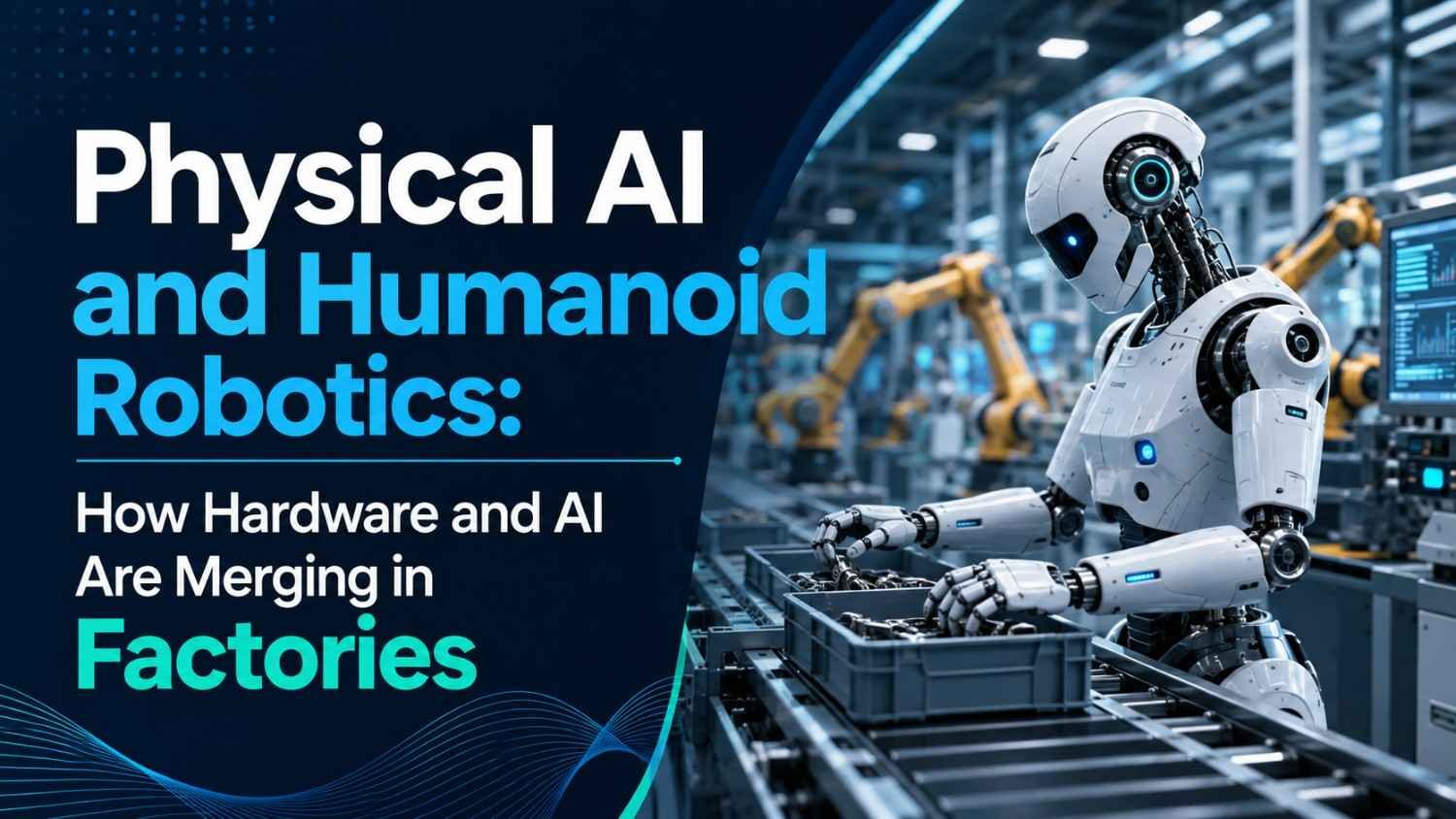
Manufacturing is stepping into a new era, where machines no longer have to stay inside the same repetitive pre-programmed routine. Old school industrial robots have been helping with automation for decades, but they can get a bit stuck when the environment is changing and the job needs actual decision-making, adaptability, and a more human-like kind of interaction. And since production requirements keep getting more intricate, plus workforce gaps are still affecting industries around the world, manufacturers are looking for smarter automation solutions that do a broader range of work, while staying safe next to people. So yeah, this movement has sparked a lot more interest in Physical AI and humanoid robotics, two tech areas that blend advanced artificial intelligence with advanced hardware, to build more capable industrial robots.
Now, unlike conventional robots, humanoid machines that use Physical AI can kind of “read” what’s around them, make sense of sensor signals, adjust when conditions shift, and carry out tasks with better flexibility. When AI models get combined with computer vision, robotics systems, sensors, and real-time choices, these machines can start assisting in assembly lines, warehouse operations, quality checks, material handling, and equipment upkeep. Even though big adoption is still kind of in progress, the combo of physical hardware and AI is quietly reshaping what manufacturing looks like. In this guide, you’ll see how Physical AI and humanoid robotics actually work, why manufacturers are investing in them, and what this tech shift means for factories worldwide .
What Is Physical AI?
Physical AI is about artificial intelligence that helps machines, robots kind of get a handle on the physical world , and then they can engage with it , even respond accordingly. That s a bit different from the more classic AI approach where systems mainly deal with digital stuff like text or still images. With Physical AI, robots can sense what’s around them using cameras, sensors, and some pretty advanced computation , and then make smart choices in real time , not later. At the same time, this area mixes machine learning with computer vision, robotics, sensor fusion , plus simulation so the machines can handle physical work in a safer way and with better efficiency. For example, in manufacturing, Physical AI lets robots adjust when the production setup starts shifting, rather than just sticking to rigid programming like a rulebook.
Key Features
- Real-world awareness.
- Intelligent decision-making.
- Continuous learning.
- Environmental perception.
- Autonomous movement.
What Are Humanoid Robots?
Humanoid Robotics is about designing robots with sort of human like structures, so they can do tasks that were mostly meant for people. In contrast to fixed robotic arms, humanoid robots often come with two legs, two arms, a bunch of joints, plus advanced sensors and AI powered software, which helps with movement, steadiness, grasping things, and even plain communication. More factories are looking into humanoid robots lately, maybe because many production environments are already set up for human workers. So, instead of redesigning whole facilities, manufacturers can sometimes roll out robots that operate the existing tools, machinery, and workstations, without all that extra overhaul, right.
Typical Capabilities
- Walking independently.
- Picking and placing objects.
- Using factory equipment.
- Navigating workplaces.
- Collaborating with employees.
Why Manufacturing Needs Smarter Robots
Modern factories are seeing a few problems , like labour shortages, production costs that keep going up, more and more product customisation, and customers who expect faster better results almost every time. Classic industrial robots are great at repetitive jobs, really exceptionally well but they can be pretty weak when something unexpected happens.Physical AI can help around these limits because it lets robots recognise objects, tune their movements, sidestep obstacles, and take decisions , also without needing a human to constantly jump in. Because of that kind of adaptability, they fit better in manufacturing settings that are more complicated and less predictable.
Industry Challenges
- Labour shortages.
- Rising costs.
- Complex production.
- Faster delivery demands.
- Safety improvements.
1. AI Helps Robots Make Better Decisions
Traditional machines do what they are told to do. They have to be programmed for every thing. This means they do not do well when things do not go as planned. With Artificial Intelligence robots can look at what’s happening around them and decide what to do. They can use cameras and sensors to figure out what is going on and make choices. This helps them react faster and work better.
Benefits of AI
- Faster reactions
- Smarter decisions
- Robots can adapt to situations
- They can work better. Make more things
2. Computer Vision Helps Robots See What Is Around Them
Computer vision is like eyes for robots. It helps them see what is around them. Understand what they are looking at. Robots can use cameras to look at things and figure out what they are. They can even see where things are and move around them.
Things robots can do with computer vision
- Look at products to make sure they are okay
- Recognize objects and know what they are
- Find problems with things
- Help them move around
3. Sensors Make Robots Safer
Safety is very important when it comes to machines and people working together. Humanoid robots use sensors to see what is around them. These sensors help robots avoid running into things move at speeds and work safely with people.
Ways sensors make robots safer
- They help robots avoid collisions
- They keep people safe
- They watch what is happening in time
- They help in emergency situations
4. Humanoid Robots Can Do Things Like People
Factories are usually set up for people to work in. Humanoid robots can work in these factories without needing a lot of changes. This makes them a good choice for factories that want to add machines to help with work.
Things humanoid robots can do
- Run machines
- Check equipment to make sure it is working
- Move materials around
- Help put things
5. AI Simulation Helps Train Robots
Training robots in a factory can be expensive and take a long time. Simulation platforms let robots learn in a world before they start working. Simulation helps robots get better at moving handling objects and making decisions without interrupting work.
Benefits of simulation
- Robots can learn faster
- It is less expensive
- It is safer
- Robots work better
6. Predictive Maintenance Reduces Downtime
AI is not just for robots. It can also watch equipment and machines to see if they need maintenance. If AI finds a problem before it happens factories can fix it before it breaks. This saves time and money.
Benefits of maintenance
- It costs less to fix things
- Machines work often
- Factories can plan better
- Everything runs smoothly
7. Warehouse Automation Is Flexible
Warehouses need to move products around manage inventory and fill orders. AI-powered humanoid robots can do these things. Help workers with tasks that are repeated over and over. They can work in places where traditional machines might not be able to.
Things robots can do in warehouses
- Move inventory around
- Sort packages
- Organize shelves
- Help fill orders
8. Humans and Robots Working Together Improves Productivity
of replacing people many factories see humanoid robots as helpers. Robots can do tasks that are repeated over and over or tasks that’re hard or dangerous. People can focus on tasks that need skills and attention.
Benefits of humans and robots working together
- People do not get as tired
- Work gets done faster
- Factories are safer
- People are happier with their jobs
9. Challenges With Using Physical AI
Even though Physical AI is getting fast there are still problems to solve. It is hard to make robots that can think and make decisions in the world. Factories also have to spend money on equipment, train workers and make sure everything is safe and secure.
Challenges with Physical AI
- It costs a lot to get started
- Batteries do not last long
- AI is not always reliable
- There are concerns about cybersecurity
- Workers need to learn skills
10. The Future of AI in Manufacturing
In the ten years Physical AI, robots and automation will change manufacturing. Factories of the future will have robots that can learn and adapt work, with people and make decisions in time.
Future trends
- Factories will be
- Robots will be able to adapt to new situations
- Production will be independent
- AI will help optimize work
Industries Already Exploring Physical AI
Although manufacturing is still one of the biggest adopters, Physical AI is starting to show up across a lot of different industries . You see it in warehousing, where firms are looking at clever logistics robots, in healthcare providers that are trialing robotic assistants , in agriculture that is moving toward autonomous farming equipment, and in construction companies that are checking AI-powered machines for both inspection and upkeep work. All those fields seem to share this same aim: getting more done faster while raising worker safety and productivity too.
Best Practices for Businesses Investing in Physical AI
If a company is thinking about Factory Automation, it should start with clear, specific goals, not jump into full-scale automation right away . A good approach is to spot repetitive work first, run small pilot programmes, put money into employee training, keep tight cybersecurity standards, and then keep an eye on how the system performs over time. It also helps to choose scalable AI platforms, you know, ones that can adapt as new technology arrives while still staying compatible with the current manufacturing setup.
Common Misconceptions About Humanoid Robotics
A lot of people assume humanoid robots will instantly swap out human workers, but today’s tech is mostly meant to assist people, not erase jobs. Another common misunderstanding is that AI-based robots run fine with zero supervision. That’s not really how it works, because real-world rollout relies on careful planning, steady maintenance, safety validation, and ongoing human oversight. Also, humanoid robots are not meant for every manufacturing job; traditional industrial robots are still often more efficient for tasks that are extremely repetitive.
Misconceptions to Avoid
- Robots replace every worker.
- AI never makes mistakes.
- Automation removes all human involvement.
- Humanoid robots suit every factory.
- Physical AI eliminates maintenance.
- Deployment is immediate.
- Only large companies benefit.
- Robots require no training.
- AI solves every manufacturing challenge.
- Hardware alone drives automation.
Conclusion
The coming together of Physical AI, humanoid robots, and more advanced hardware is kind of reshaping the future of manufacturing. It’s letting machines move past only repetitive automation, and then actually interact in an intelligent way with the physical world. In practice, these technologies help factories boost output, improve safety for workers, deal with labour shortages, and build more flexible production systems that can respond to shifting business needs, you know, without so much drama. Sure, there are still issues around cost, regulation, and the technical level of complexity, but the ongoing progress in Artificial Intelligence and industrial robotics keeps pushing adoption of smarter factory automation forward. So companies that really choose to lean into these innovations now will likely be in a better spot to compete in the more and more intelligent manufacturing settings that are coming next.
Frequently Asked Questions
1. What is Physical AI?
Physical AI is artificial intelligence that enables robots and machines to understand, interact with, and make decisions within real-world physical environments using sensors, computer vision, and advanced AI models.
2. How are humanoid robots different from traditional industrial robots?
Humanoid robots are designed to perform tasks in environments built for humans. They can walk, manipulate objects, use existing equipment, and adapt to changing situations more easily than many fixed industrial robots.
3. Which industries can benefit from Physical AI?
Manufacturing, warehousing, healthcare, agriculture, logistics, construction, and retail are among the industries expected to benefit significantly from AI-powered robotics and intelligent automation.
4. Will humanoid robots replace factory workers?
Current humanoid robots are primarily intended to assist human workers by handling repetitive, dangerous, or physically demanding tasks while allowing employees to focus on higher-value responsibilities.
5. What are the biggest challenges facing Physical AI?
Key challenges include hardware costs, battery technology, AI reliability, cybersecurity, safety regulations, workforce training, and integrating intelligent robots into existing manufacturing systems.
Leave a Reply