
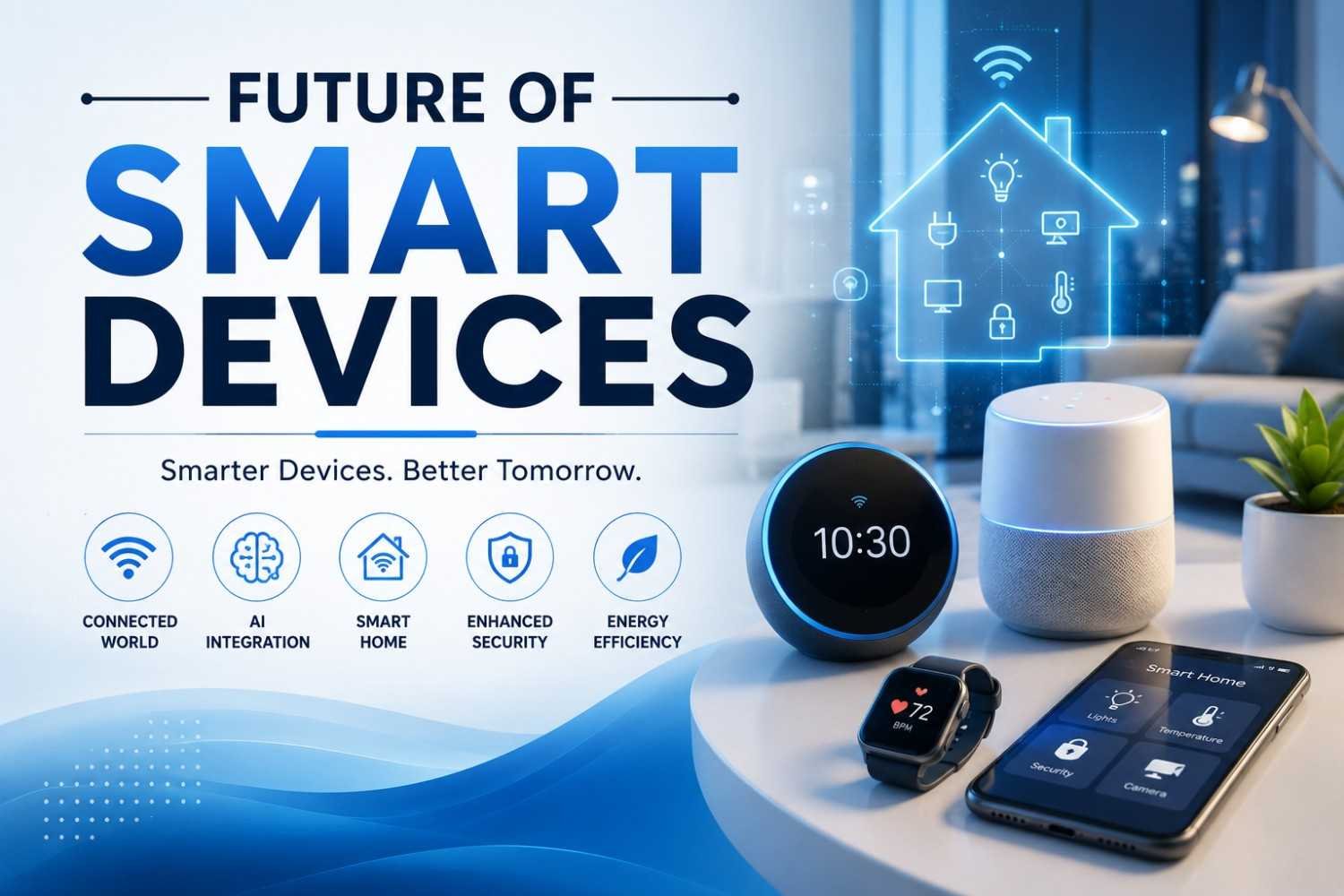
Smart devices have somehow become an essential part of modern life. From smartphones and smartwatches, to smart TVs, voice assistants, connected home appliances, and wearable technology, these intelligent gadgets have shifted how people chat, work, study, and manage day to day routines. What once felt like futuristic tech. is now a pretty normal part of homes and offices around the world, and as innovation keeps speeding up, smart devices are getting more capable, more connected, and able to complete tasks with less human involvement.
The future of smart devices is being pulled forward by advanced technologies like Artificial Intelligence (AI), the Internet of Things (IoT), cloud computing , edge computing, and quicker wireless networks such as 5G. With these tools, devices can talk to each other, pick up patterns about user behavior, automate the same repetitive work, and also deliver experiences that feel tailored. Instead of operating alone, future smart devices are expected to cooperate, kind of like part of one connected digital ecosystem, which should raise convenience, efficiency, security, and overall quality of life.
Businesses have been leaning into smart technology as well, to boost productivity, automate operations, monitor equipment, and create smoother customer experiences. In healthcare, providers use connected medical devices for remote monitoring, while manufacturers lean on smart sensors to tune up production processes. Education, transportation, agriculture, and retail are all benefiting from intelligent connected devices, that help make day to day operations run more smoothly, and in many cases more data-driven too.
In this comprehensive guide, we’ll look at the Future of Smart Devices, talk through the technologies driving innovation, and examine real world applications and explain how these intelligent systems will continue transforming our everyday lives.
Why Smart Devices Are Becoming More Popular
Consumers are really starting to expect technology that’s fast, convenient, and somehow more capable of simplifying daily life. Smart devices kinda hit that sweet spot by taking over routine tasks automatically, making communication easier, and delivering these more tailored, “just for you” experiences.
With internet connectivity getting better , and technology becoming more affordable, smart devices are now being rolled out across homes and businesses, also healthcare, education, and even the industrial sectors.
Key Benefits of Smart Devices
- Simplify daily routines.
- Improve productivity.
- Enhance convenience.
- Strengthen security.
- Save time and energy.
- Support smarter decision-making.
These advantages continue driving global demand for connected technology.
1. Artificial Intelligence Will Make Smart Devices More Intelligent
Artificial Intelligence is becoming the foundation of generation smart devices. Of just doing what we tell them to do future devices will learn what we like figure out what we want and give us suggestions that are just for us. Artificial Intelligence will help devices understand what we say recognize pictures look at how we use them and make decisions without us having to tell them what to do all the time.
Why Artificial Intelligence Is Important
Artificial Intelligence turns devices into smart helpers that can make our lives easier more convenient and more personalized. Over time devices will get better at knowing what we need and changing automatically.
Key Artificial Intelligence Features
- Devices will get better at recognizing our voices.
- They will be able to guess what we want.
- They will be able to do things just for us.
- They will be able to schedule things
- They will be able to suggest things that’re smart.
- They will be able to help us make decisions in time.
Business and Personal Benefits
- Artificial Intelligence saves us time.
- It makes using devices fun.
- It reduces tasks that we have to do over and over.
- It helps us get work done.
2. Internet of Things Will Connect Everything
The Internet of Things allows smart devices to talk to each other through the internet making a network of things. Of working alone future devices will share information automatically making things more efficient at home at work in healthcare in transportation and in factories.
Why Internet of Things Matters
When devices are connected we do not have to do much work and they can work together smartly.
Examples of Internet of Things Integration
- Smart refrigerators can talk to grocery apps.
- Security cameras can talk to locks.
- Lighting systems can change automatically.
- Connected healthcare devices can share information.
- Smart cars can talk to traffic systems.
- Industrial machines can check how they are doing in time.
Benefits
- Things will get done automatically.
- It will be more efficient.
- It will be more convenient.
- We will be able to make decisions.
3. Smart Homes Will Become Intelligent
Smart Home Technology is getting better and better it is not just about turning lights on and off with our voices. Future homes will change lighting, temperature, entertainment, security and energy use automatically based on what we like and what we do every day.
Why Smart Homes Matter
Controlling our homes automatically makes us more comfortable. Helps us save energy and be safer.
Smart Home Innovations
- Homes will have climate systems that are controlled by Artificial Intelligence.
- Lighting will change automatically.
- Window blinds will. Close automatically.
- Kitchen appliances will be smart.
- We will have connected entertainment systems.
- We will be able to control our homes with our voices.
Benefits
- We will save money on energy.
- We will be more comfortable.
- Our homes will be safer.
- It will be more convenient.
4. Healthcare Will Benefit from Smarter Devices
Healthcare is one of the areas that is changing the most because of devices. Future medical devices and smart health devices will check on patients all the time. Warn us if someone might get sick.
Why Smart Healthcare Matters
Doctors will be able to get information about patients in time which will help them diagnose problems and reduce hospital visits.
Future Healthcare Applications
- We will be able to check our heart rate all the time.
- We will be able to track our blood pressure.
- We will get reminders to take our medicine.
- Artificial Intelligence will help analyze our health.
- We will be able to check on patients from away.
- We will get emergency alerts if someone is sick.
Benefits
- We will be able to prevent illnesses.
- We will be able to find diseases
- Patients will be safer.
- Healthcare will be more accessible.
5. Smart Security Systems Will Become Advanced
Security technology is getting smarter and smarter with Artificial Intelligence and automation. Future Smart Security systems will find activity more accurately and reduce false alarms.
Why Smart Security Matters
Modern security solutions protect our homes and businesses by giving us alerts and watching everything intelligently.
Advanced Security Features
- We will have recognition.
- We will have motion detection.
- Artificial Intelligence will power surveillance.
- We will be able to watch from away.
- We will have access control.
- We will get emergency alerts automatically.
Benefits
- Our property will be safer.
- We will be able to respond to emergencies
- We will be able to watch everything easily.
- We will feel safer.
6. Wearable Technology Will Continue Expanding
Wearable Technology is getting better and better it is not about tracking our fitness. Future wearable devices will be smaller, smarter and more accurate.
Why Wearables Matter
Wearables give us information all the time without us having to look at our phones.
Future Wearable Features
- We will be able to track our health accurately.
- We will be able to translate languages in time.
- We will have support for augmented reality.
- We will have payment systems.
- We will have tools to help us work better.
- We will have fitness coaches.
Benefits
- We will be more aware of our health.
- It will be more convenient.
- We will be able to move more easily.
- We will be able to communicate
7. 5G Technology Will Unlock New Possibilities
The expansion of 5G Technology will make smart devices work better. Faster internet speeds and lower delays will allow connected devices to talk to each other instantly.
Why 5G Matters
Reliable high-speed connectivity supports advanced automation and real-time communication.
Applications of 5G
- We will have cities.
- We will have connected cars.
- We will have automation.
- We will have healthcare.
- We will have collaboration.
- We will have real-time cloud computing.
Benefits
- We will be able to communicate
- It will be more reliable.
- We will have streaming.
- Connected devices will work better.
8. Smart Devices Will Improve Workplace Productivity
Businesses are using technology to automate work, watch equipment and help people work together. Smart devices will keep supporting work environments and digital workplaces.
Why Workplace Automation Matters
Connected technology helps employees work efficiently and reduces tasks that we have to do over and over.
Workplace Applications
- We will have meeting rooms.
- We will have scheduling assistants that are powered by Artificial Intelligence.
- We will have connected office equipment.
- We will have collaboration tools.
- We will be able to watch inventory.
- We will be able to track how productive employees are.
Benefits
- We will be more efficient.
- We will work better.
- We will be able to make decisions
- It will cost less to operate.
9. Sustainability Will Shape Future Smart Devices
Technology companies are focusing on being kind to the environment. Future smart devices will use energy be made from materials that can be recycled and support sustainable manufacturing practices.
Why Sustainability Matters
People care more and more about technology that’s friendly to the environment reduces waste and saves resources.
Innovations
- We will have processors that use less energy.
- We will use materials that can be recycled.
- We will have devices that are powered by energy.
- We will have packaging that’s eco-friendly.
- Devices will last longer.
- We will reduce waste.
Benefits
- We will help the environment less.
- We will use energy.
- Devices will last longer.
- It will be better for consumers.
10. Cloud Computing Will Enhance Smart Device Capabilities
Cloud Computing allows smart devices to store, process and share data across platforms. Of just using the device itself future devices will use cloud services to update faster and have more advanced Artificial Intelligence capabilities.
Why Cloud Integration Matters
Cloud platforms make it easy to share data and reduce storage limits.
Cloud Features
- We will have backups.
- We will be able to use data on devices.
- We will be able to access data from away.
- Artificial Intelligence will power processing.
- We will have secure cloud storage.
- We will get software updates.
Benefits
- We will be able to access data easily.
- It will be more flexible.
- We will work better.
- We will manage data strongly.
Challenges Facing Smart Devices
Even though smart technology has benefits there are still some challenges.
Challenges
- We are worried about data privacy.
- We are worried about cybersecurity.
- Devices are not always compatible.
- We need the internet to work.
- It can be expensive to start.
We have to use Artificial Intelligence . If we can solve these challenges people will trust technology more.Tips Before Investing in Smart Devices . We need to plan before buying smart devices.
Buying Considerations
- We need to make sure devices are compatible.
- We need to think about security and privacy.
- We need to check if the company will support the device.
- We need to think about battery life.
- We need to make sure it is easy to use.
- We need to think about if it will be good, in the long term.
- Investing in reliable technology provides better long-term value.
The Future of Smart Devices
The future of smart devices is kind of centered on intelligence, automation,and connectivity. Over time, these gadgets will get more and more capable at understanding how people behave, exchanging data with each other, and making real-time decisions that quietly make daily routines feel easier.
As Artificial Intelligence, Internet of Things, Cloud Computing, and 5G Technology keep advancing, smart devices will move past “just convenience” and turn into essential instruments for healthcare, education, transport, business workflows, and home management. Rather than only responding to the spoken command, later devices will proactively help , they will anticipate certain needs, and they will craft very personalized experiences for each person in a more or less constant way.
Conclusion
The Future of Smart Devices kind of represent one of the most exciting developments in modern tech, and honestly it feels like it’s moving quicker than expected. With leaps in Artificial Intelligence, Internet of Things, Smart Home Technology, and cloud computing, connected gadgets are getting smarter, faster ,and more capable, in a way that can really improve everyday life.
You can see it in intelligent healthcare monitoring and workplace automation and also in advanced home security, plus the sustainable kind of technology. Smart devices are changing how people live, and how they get work done. Businesses will likely get a boost from efficiency and automation, while consumers can enjoy better convenience, stronger safety, and more tailored personalization.
And as innovation keeps coming, adopting smart tech thoughtfully should help individuals and organizations take full advantage of this connected world that’s arriving. The future isn’t only about owning smart devices—it’s about building intelligent ecosystems that make life simpler, more productive,and more connected, sort of together.
Frequently Asked Questions
1. What are smart devices?
Smart Devices are internet-connected electronic products that use software, sensors, and communication technologies to perform tasks automatically, collect data, and interact with users or other devices.
2. How will AI improve smart devices?
Artificial Intelligence will enable devices to learn user preferences, automate daily tasks, provide personalized recommendations, improve voice recognition, and make smarter decisions without constant manual input.
3. What role does the Internet of Things play in smart devices?
The Internet of Things (IoT) connects devices so they can exchange information, automate processes, and work together as part of an intelligent digital ecosystem.
4. Are smart devices secure?
Most modern smart devices include advanced security features, but users should keep software updated, use strong passwords, enable multi-factor authentication when available, and follow recommended cybersecurity practices.
5. Why are smart devices becoming more popular?
Smart devices improve convenience, increase productivity, enhance security, support energy efficiency, and simplify everyday tasks, making them valuable for both personal and professional use.
Leave a Reply